
博凯森生物 provides CRISPR-Cas9 knockout validation and potential off-target detection in a high-throughput and cost-effective manner by harnessing advanced next generation sequencing (NGS). Our team members have experience in both genome editing and NGS, enabling extensive support to your research.
什么是CRISPR-Cas9系统?
CRISPR-Cas9基因靶向系统需要两个组件:定制导向RNA(sgRNA,由靶特异性crRNA序列和tracrRNA组成)和非特异性CRISPR相关内切酶(Cas9),这是一种新的基因组工程工具,使研究人员能够通过删除、添加或更改生物体中DNA序列的一部分来编辑基因组的一部分。它是目前最简单、最通用、最精确和有效的基因操作方法,具有许多潜在的应用,包括医学和作物种子增强。CRISPR-Cas9也被用于实现高通量基因组编辑,并彻底改变了靶向突变的产生。
CRISPR测序介绍
验证编辑在CRISPR实验过程中尤为重要。下一代测序(NGS)是一种简单且高通量的方法,用于检查所需的突变,因为可能会发生脱靶突变,而不是靶基因的编辑。CRISPR扩增子测序已成为学术界、临床和工业界的标准化验证技术。高通量CRISPR筛选基于靶向扩增子测序的原理,通过使用靶区侧翼的引物进行PCR实验。靶向扩增子测序是检测突变最敏感的方法,检测频率低至0.01%。
To address the emerging needs of research communities, 博凯森生物 has developed an affordable, reliable, and high-throughput strategy for screening and validating CRISPR-Cas9 based mutations by harnessing amplicon based next-generation Sequencing. Our CRISPR next-generation sequencing service can give you direct and detailed information about the nature and diversity of the mutations, including confirmation of knockout/knockin alleles, assessment of sgRNAs cutting efficiency, homozygous and heterozygous identification, mutation frequencies calculation 等.
CRISPR Sequencing Workflow
我们经验丰富的专主页团队遵循每一个程序执行质量管理,以确保全面准确的结果。我们的CRISPR突变测序工作流程概述如下,包括DNA分离、PCR实验、深度测序和数据分析。我们的CRISPR突变测序使研究能够验证指南库,验证CRISPR/Cas9靶点和突变效率,以及发现最有前景的靶位点。
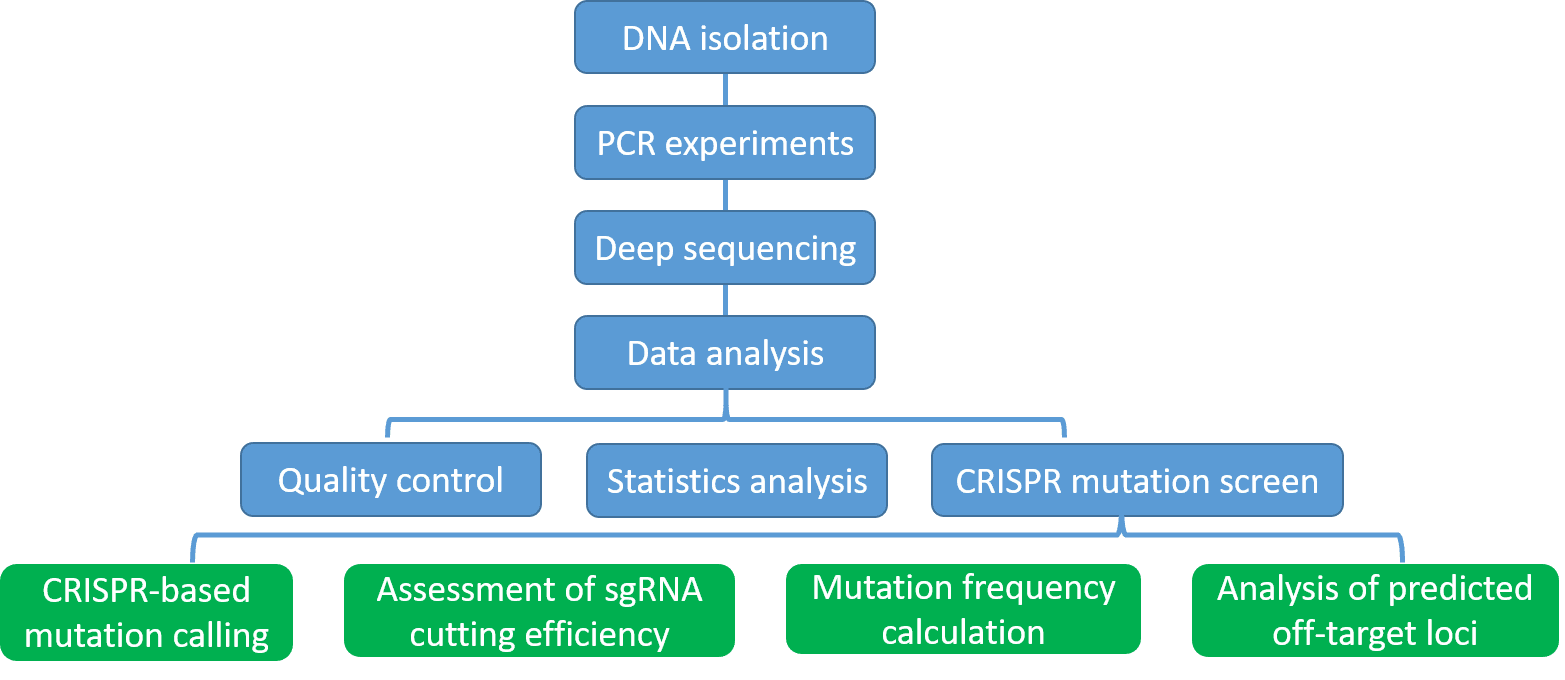 图1。我们的CRISPR扩增子测序工作流程。
服务规范
 |
样品要求和制备
|
 |
深度测序
|
 |
生物信息学分析
|
我们的优势
- Extensive multiplexing flexibility and high-throughput sequencing, up to 104. 每次运行的样本数
- 扩增子或捕获区域的超深度测序,覆盖范围超过1000倍
- 成本效益高,检测水平高,无偏差
- No need for laborious and time-consuming cloning steps
- 专业博士级科学主页的全力支持
博凯森生物 is able to help you to detect the potential off-target effects via targets enrichment and deep sequencing at fairly inexpensive prices. We can sequence hundreds of samples simultaneously. The InDel distribution pattern will be analyzed and mutation can be confirmed with the CRISPResso tool. If you have additional requirements or questions, do not hesitate to contact us.
CRISPR/Cas9介导的原代人T细胞受体工程的全基因组脱靶分析
期刊: 临床与转化免疫学
影响系数:5.8
发布时间:2021
测序服务策略: 全基因组测序(WGS)
摘要:
利用T细胞防御癌症是当代免疫治疗策略中的一个突出方法。基因工程 T细胞受体 能够重新定向T细胞特异性,消除同种异体反应,并推进过继性T细胞转移(ACT)治疗。通过CRISPR/Cas9技术引入DNA双链断裂有助于基因敲除或敲入操作。确定工程T细胞安全性的一种有效方法涉及检测整个基因组中的脱靶基因。利用CRISPR/Cas9技术,作者利用核糖核蛋白递送来敲除TCR,使他们能够评估基因工程T细胞的安全性。随后采用全基因组测序来研究CRISPR/Cas9介导的TCR位点双链断裂是否与原代T细胞中的脱靶效应有关。
结果:

The safety of T cells was assessed by examining nonspecific nuclease-induced off-target incidents. Utilizing Cas-OFFinder, the authors screened for matching sites with a mismatch of ≤ 4 between the guide RNA (gRNA) and non-target DNA, considering them as possible off-target locations. Subsequently, whole-genome sequencing was carried out on both untreated samples and MOCK samples. The results revealed that electroporation alone did not yield any significant genomic variations.
然后,作者对经过TRAC和TRBC编辑的样本进行了全基因组测序,不包括在未经处理和MOCK样本中发现的InDels。他们使用基于单导向RNA(sgRNA)的全基因组同源序列比对,在TRAC编辑的样本中鉴定出316个不同的InDels,在TRBC编辑的样本中共鉴定出272个不同的InAls。这些潜在的脱靶位点随后由作者汇编。